There is little that is new about attempts to achieve a united Ireland. The partition of Ireland was resisted from the beginning. Multiple strategies have been deployed to bring the Union with Britain to an end. Thus far without success. Given the nature of the jurisdiction this was always going to be a challenge. ‘Northern Ireland’ was constructed to last; an in-built unionist majority that would ensure longevity. Delivering a united Ireland in those unfavourable circumstances might appear a forlorn hope, resting in a change of heart in London.
A region designed to head off the prospect of constitutional change. Something has recently shifted dramatically though. In 2026 the prospect of Irish unity looks closer than ever. We are entering a period when a border poll is potentially winnable in the North. Stop and ponder that. Reunification is now within our grasp. A centre-stage discussion across Ireland and beyond. The intention here is to explore why this happened, with particular reference to the contribution of Ireland’s Future – a civic group campaigning for a united Ireland. Before doing that there is a need for context and background.
Framing Self-Determination
The end of the conflict in Ireland was assisted by broad support for a constitutional compromise on the right of self-determination. This is spelt out in the Good Friday Agreement 1998 and is a matter of law and politics. The commitments have been incorporated into the domestic law of both states. These were regarded as so significant that the precise legal texts were included in the Agreement.
The right belongs to the people of Ireland – North and South – and it will be exercised by concurrent referendums, a democratic vote in each jurisdiction on the island. The people of Ireland determine the future. The British government must operate with rigorous impartiality: a border poll triggered when it appears likely a majority in the North would vote for change. While this step may be taken at any time – subject to limitations clarified in litigation – the focus is usually on electoral and polling evidence. The constitutional status of the North rests on a democratic choice, with extensive reference in political life to what is termed the ‘principle of consent’. The region remains part of the Union with Britain only on the basis of a judgement about ongoing consent. It is easy to see why the rise of Sinn Féin, combined with evidence of a closing gap between the pro-Union and pro-Unity sides, has attracted significant attention.
Responding to Brexit
Brexit features prominently in accounts of the accelerated interest in Irish unity. It is not difficult to see why. Little thought was given to the complexities of Ireland by the English nationalists who continue to drive this project. Decades of anti-European propaganda fuels a narrow politics of withdrawal and retreat.
Common membership of the EU held a valuable place in the delicate politics of the peace process, so Ireland watched events with alarm. Early preparations were made by the Irish state in case the worst possible option prevailed. Attempts to warn people about the consequences had an impact. The electorate in the North rejected Brexit, but the UK-wide nature of the referendum meant that the region was never really going to be decisive. The absence of consent here did not prevent Brexit. The particular circumstances of the island of Ireland did mean that special arrangements were required.
A long-running and divisive debate about the now Windsor Framework ensued. The primary objective was to avoid a hard border and mitigate some of the damage. Prompted by the Irish government at the time, in April 2017 a statement from the European Council provided the assurance that a vote for unity – within the terms of the Agreement – would mean automatic return to the EU for the North: the whole territory of the island would be part of the EU. This neglected feature of the post-Brexit landscape merits amplification today. It makes the position in the North distinctive and will smooth the path of reunification – if that is what the people of Ireland decide.
Mobilising for Constitutional Change
Where does Ireland’s Future figure in this picture? Like many civic movements the arrival of a formal organisation was a steady process of evolution, prompted initially by grave concerns about the implications of Brexit for the North. Those involved in Ireland’s Future often tell the story of conversations happening in everyday settings – people genuinely worried about what was coming next and wanting a collective response. All taking place in communities still dealing with the legacies of conflict and instability, where a feeling remained that the promises of the peace process were yet to make a real difference.
What started as a letter-writing campaign to the Irish government in 2017 and 2018 – focused on gathering signatories on questions of rights and citizenship – developed into a dedicated movement for constitutional change. People across society in the North wanted to signal the depth of unease and to do so publicly. That in itself was a courageous step. Frequent references to the re-partition of Ireland indicated just how strongly republicans/nationalists felt about the consequences of Brexit. Ireland’s Future emerged from that public mood. A belief also that the option of a united Ireland needed to feature in the national conversation. A determined attempt to turn the words of our peace agreement on unity into a reality; a transition from talking in the abstract about consent to exercising the constitutional choice.
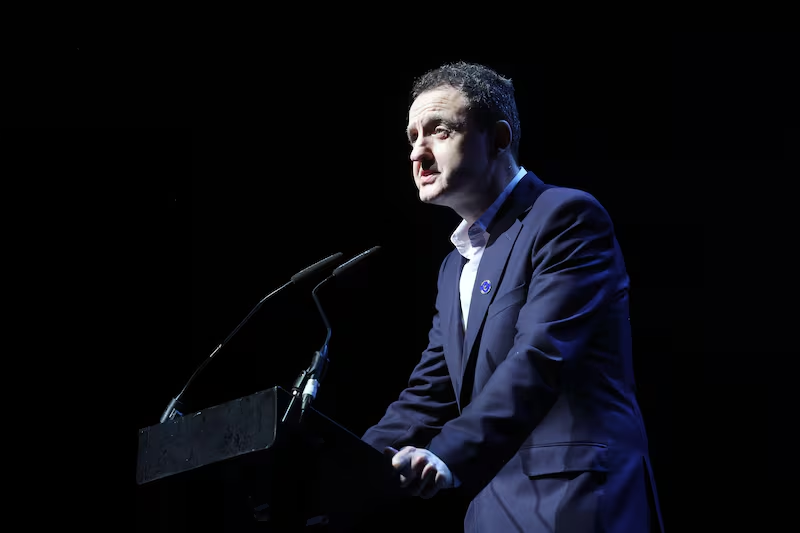
What was at first a loose coalition of people from all walks of life transformed into a formalised structure. In the spirit of any civic initiative this has all been taken forward with enormous amounts of generosity and good will; people trying to do what they can to help. Those who stepped up knew well from the history of this place what might follow. The initial pushback was severe but was tempered by the remarkable levels of enthusiasm and support. Ireland’s Future was responding in a constructive way to a real demand for action. The first phase was about aware-raising, placing Irish unity back on the agenda and at the centre of public life. The scale of this ambition is evident in the venues selected for our public events. The Waterfront Hall (Belfast, 2019), the Ulster Hall (Belfast, 2022), the 3Arena in Dublin (2022) and the SSE Arena in Belfast in June 2024.
These were mass civic gatherings and spectacular occasions that will in time be seen as historic landmarks on the unity journey. Looking back now what is striking is the emphasis on inclusion, with a broad range of participants from across political and public life. The breadth of engagement is really quite remarkable. Major public figures from political and civic life willing to take to the stage that Ireland’s Future made possible. Thousands of people packed into arenas to hear about a united Ireland. These set piece dialogues were supplemented by smaller scale conversations across the island. We were putting constitutional change back on the map.
Much of our activity was recorded, is available still and has attracted huge online audiences. What at times in the past seemed like a peripheral debate about a distant aspiration is now occupying the minds of key players. This high-profile public engagement was supplemented by policy papers, opinion pieces and other interventions. In our early documents, such as The Conversation on Ireland’s Future: A Principled Framework for Change (2020) and Advancing the Conversation: The Way Forward (2021) we published our thoughts on ways forward and how the discussions should be framed. These documents merit a fresh look. Our aim was to put language and ideas out there for others to adopt and use. We tried hard to think of novel ways of doing this. We wanted to appeal to the broadest possible audience. We worked on answering questions. And we were heartened when our framing proved influential and impactful. Ireland’s Future was ‘making the weather’ in that period. We proposed a set of principles that have held up over time, influenced by the work of others too, such as the Constitutional Conversations Group.
From an early stage we knew that socio-economic arguments were going to be decisive. That is why we produced Planning for a Strong Economy in a New Ireland (2021), where we explored the evidence-based case for change. This work was assisted by new comparative research that was upending long-established myths about the performance of each jurisdiction. We also realised that without rock-solid legal assurances on, for example, rights and citizenship the unity project was going to flounder. Unionists, for example, need to know that guarantees are more than mere shallow rhetoric confined to speeches in conference halls. In Rights, Citizenship and Identity in a United Ireland (2021) we underlined the significance of the legal framework that would guide the next steps. One glance at those involved in Ireland’s Future is an indicator of how seriously we take equality and human rights. We remain determined to ensure that the mistakes of previous generations are not repeated.
It is worth pausing here to reflect on how Ireland’s Future responded and to acknowledge how valuable this was. In the face of deep anxiety about the impact of Brexit, and with the risks of profound instability, we brought people together to talk positively about the future. In a spirit of inclusion, consensus and coalition building, without apologising about our constitutional objective. Not only that but Ireland’s Future – in the space of a short period of time – put multiple ideas out there for civic discussion and debate. The negative reaction to Ireland’s Future – and its core members – appears baffling in retrospect.
This growing effort was followed up with Shaping a New and United Ireland (2022), where we gathered together additional contributions on social security, sport and the environment. That document also provides a helpful snapshot of the work we had completed. All produced in time for our event in the 3Arena in Dublin in October 2022. In many of our meetings the number one issue is health care, so that is why in 2023 we produced An Opportunity for a World Class All-Island National Health Service where we emphasised the potential for a better future for everyone on the island, building on the lessons learned from experiences in each jurisdiction.
We are a small civil society organisation. We depend on the good will of people with busy lives. We knew then and still know that more detailed work must follow. We do not overclaim, but we believe we cleared an early pathway. That is why we have been relentless in our emphasis on the need for additional governmental planning and preparation. We are a campaigning group that wants to achieve a united Ireland. We see our role and our job to push forward the debate. We understand that may irritate and annoy at times. We would be failing if that were not the case. We are not content simply to repeat the messaging around planning. We take that as basic and as essential. We want to exercise our right to decide in practice.
That is why we insist on placing a timeframe on the table and that is what makes our 2024 document Ireland 2030 such a major intervention in the policy debate. In that document we sketched out a detailed pathway to change between the period 2024-2030. This included the preparatory steps required before a border poll. Our document is carefully constructed in the language of proposals and suggestions, with thoughts on options, particularly on the role of the Irish government in the planning phase. While attention is often given to Westminster, for us the Irish state is key. Why? Because in our view – in normal diplomatic circumstances – London is unlikely to move unprompted by Dublin. That does not mean that a future British government might be tempted to trigger a border poll unilaterally. It is simply that when Dublin signals the time is right then that will send a powerful message. Would Britain, for example, resist?
As hinted at earlier, an objective observer will notice a measure of hostility to Ireland’s Future. Trying to bring a conversation about Irish unity centre stage was never going to be easy. Many of the existing political, social, cultural and institutional defaults across public life in the North are pro-Union. They are so embedded that they are often taken for granted. That is why Ireland’s Future remains so grateful to all those who have been willing to engage.
Where Now?
Credit claiming is a risky business in the age of the attention economy. But Ireland’s Future – as a civic group that prioritises constitutional change – can be assured that it has contributed to moving the dial significantly. Without the efforts of Ireland’s Future there would be less of a focus on unity today.
Ireland’s Future was established to achieve a united Ireland. Not only to ensure adequate preparation but to deliver a border poll and win it. That is why we are advocating a timeframe, with all the preceding elements. We know that on this island there is an implementation deficit; promises made without action. In the North awareness of this gap is acute. Our approach is not universally welcomed, even by some who favour unity. But it will come as no surprise to anyone who has followed our work closely. We want the choice to be offered – we demand responsible planning in advance – but not as a convenient substitute for a border poll.
The required steps are already well rehearsed. The need for all-island civic dialogue, the role of a formal government structure in doing the preparatory work, the place of the Oireachtas, with a dedicated committee addressing the questions. This should all lead to a consultative Green Paper and eventually the production of what Ireland’s Future calls a Programme for a New Ireland. That will be the document where proposals are formally set out. Also key will be intergovernmental dialogue – leading to at least one new British-Irish Agreement. Although more unilateral scenarios cannot be entirely ruled out – the most likely and desirable approach is one that is well managed by both governments, political and civic leaders and involves significant levels of procedural buy-in. There will be turbulence and it will be contested. But this project is achievable, affordable and can be managed well.
Often neglected is that this will play out in an existing EU member state and there will be international friends of the process of reunification. Equally significant is that established good relations with Britain must be maintained. The right of self-determination belongs to the people of this island – and the implications of that framing risk being neglected – but ensuring sensitivity to the dynamics of these islands is essential. Ideally Britain will return to the EU, and a good bilateral partnership will endure. That is on the assumption – itself open to question – that Britain will survive as an entity, given the strength of the movement for self-determination in Scotland, for example. Thought may well be required on new forms of association across these islands that builds on existing post-Agreement structures.
Whatever happens next, Ireland’s Future has secured a well-earned legacy of transforming the conversation. Some will say that is overblown, and board members like me are perhaps too close to it all. But the organisation has succeeded in achieving its initial aims. New ground was broken; Irish unity is mainstream. Not alone and not without significant assistance – but an impactful contribution none the less. As more books, research papers, podcasts and other activities emerge, Ireland’s Future faces into a different phase of this constitutional journey.
Those who work for Ireland’s Future tend to have an optimistic mindset and see the opportunities and the benefits – activists who are inspired by the potential of overcoming destructive separation and division. The clue is in the title: a united Ireland. People who take constitutional promises seriously, who know that the Union can be brought to a peaceful and democratic end in the best interests of everyone across these islands. That is the positive and constructive spirit that will guide the leadership of Ireland’s Future as a collective civil society movement for transformative change.
Colin Harvey is a board member of Ireland’s Future and a Professor in the School of Law, Queen’s University Belfast